
The 2026 Developer Roadmap: Why You Must Start with Dev (and Ignore the AI Hype)
AI Summary
Tap Generate and let AI do the magic
There is a huge myth scaring students in 2026: "AI is going to replace developers, so why bother learning to code?"
If you listen to this, you’ll miss the biggest opportunity of the decade. The reality isn't that AI is replacing developers—it’s that AI is giving developers superpowers. In 2026, the real winners aren't the ones who can solve a LeetCode "Hard" in their sleep; they are the "Builders" who can ship real products at lightning speed using AI as their co-pilot.
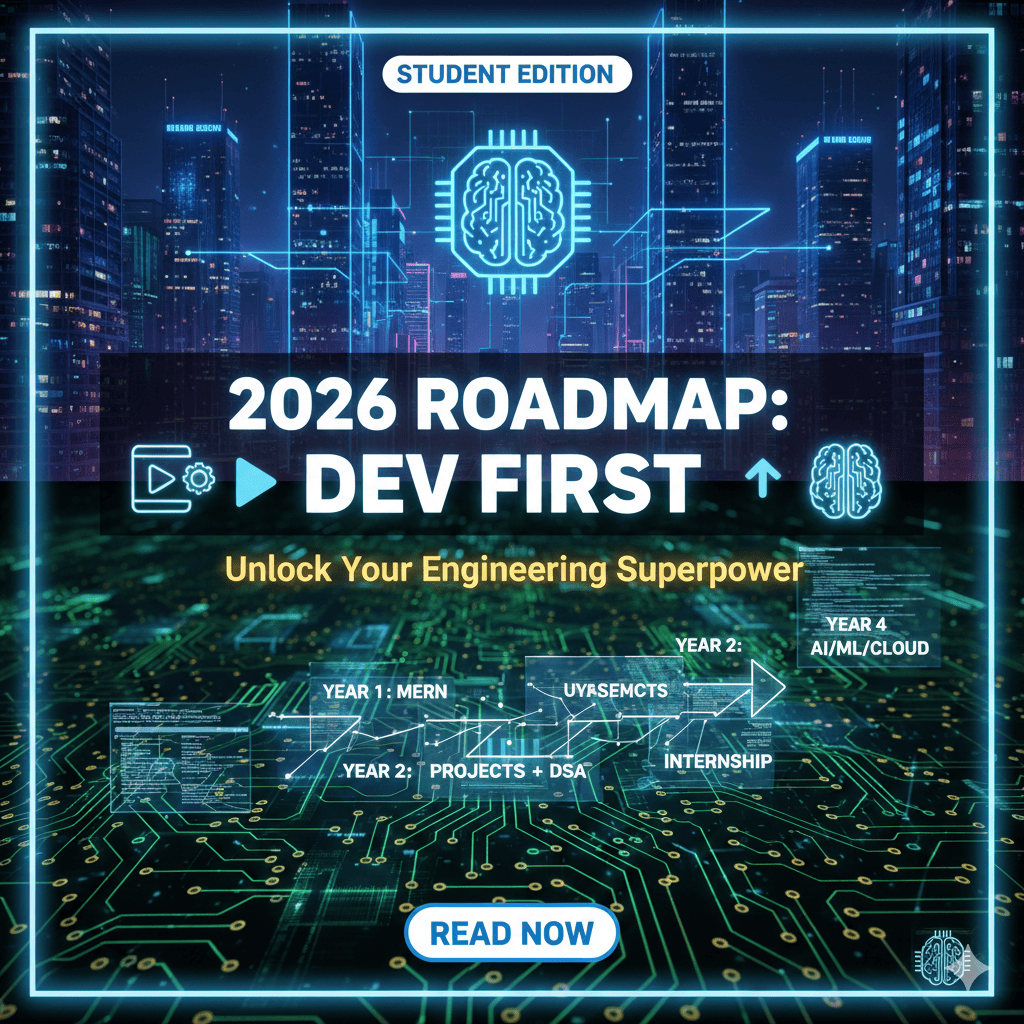
Here is the ultimate 4-year roadmap to becoming an unstoppable engineer.
Step 1: Start with Development (Don't touch DSA yet!)
Most seniors will tell you to grind Data Structures and Algorithms (DSA) first. In 2026, this is a mistake.
Why Dev First?
- Immediate Feedback: Building a website or a Windows app gives you a "win" you can see. DSA can feel like abstract math that leads to burnout.
- AI Leverage: You can now use AI agents to scaffold entire backends or debug CSS in seconds. This allows you to build complex apps that would have taken a senior dev months to build just three years ago.
- The Reality Check: AI isn't replacing you; it’s making you a Digital Architect. You need to know how the pieces (Frontend, Backend, Database) fit together before you worry about optimizing an array search.
My Recommendation: Start with the MERN Stack (MongoDB, Express, React, Node.js). It is the most robust, well-documented, and "AI-friendly" stack for beginners.If starting dev you should read this blog https://blog.studentsenior.com/the-2026-developers-guide-types-of-development-stacks-and-why-ai-is-your-new-best-friend
Step 2: The "Two Big Projects" Rule (Year 1-2)
Your goal for the first year is not to learn 100 languages. It is to create two massive, high-quality projects.
- Project 1: A Solution-Based SaaS. Build something people actually use (e.g., an AI-powered study planner for your university).
- Project 2: A Real-Time Scalable App. Build a real-time collaboration tool or a high-traffic marketplace.
Why? In 2026, recruiters don't care about "To-Do Lists." They want to see that you understand system architecture and how to prompt AI to write clean, secure code.
Step 3: Pivot to DSA & Internships (Year 2-3)
Once you have built real things, your brain is "wired" for logic. Now is the time to start DSA.
- Logic over Syntax: Because you’ve already built apps, concepts like "Linked Lists" or "Trees" will actually make sense because you've seen where data gets stored in a real database.
- Start the Internship Hunt: With two big projects on your resume, you will stand out instantly. Apply for internships while you are still learning DSA. Many startups care more about your ability to ship features than your ability to invert a binary tree.
Step 4: The Multi-Tech Expansion (Year 3-4)
By your 4th year, you should have your "Core" (MERN + DSA) locked down. Now, follow your curiosity:
- AI/ML: Learn how to integrate LLMs into your apps.
- Cybersecurity: In an AI world, "DevSecOps" is the highest-paying niche.
- Cloud: Learn AWS or Azure to host your massive projects.
Summary: The 4-Year Success Path
| Year | Focus | Key Milestone |
|---|---|---|
| Year 1 | MERN Stack | Build 1st Big Project |
| Year 2 | Full-Stack Mastery | Build 2nd Big Project + Start DSA |
| Year 3 | DSA & Internships | Land your first 6-month Internship |
| Year 4 | Specialization | Learn AI, ML, or Cloud; Prep for PPO |
Final Thought
The "DSA vs. Dev" debate is over. The 2026 industry wants Engineers, not just "Coders." Start building today, use AI to move fast, and by the time you reach your 4th year, you won't just be looking for a job—you'll be choosing between them.