
Meta Muse Explained: How Its AI Agent Can Actually Get Things Done
AI Summary
Get a quick overview of the key points
Tap Generate Magic to let AI read for you.
Imagine asking an AI to plan your trip, compare products, fill out forms, and organize your schedule. Instead of just giving you instructions, it works through the steps for you.
That is the idea behind Meta Muse, Meta's personal AI agent announced in September 2026.
AI tools can already answer questions, write code, and generate content. Muse takes this idea further by focusing on completing tasks, not just answering questions.
Let's understand how it works and why it matters to developers.
What Is Meta Muse?
Meta Muse is a personal AI agent designed to complete tasks across supported websites and services.
It is powered by Muse Spark, Meta's AI model designed for real-world tasks.
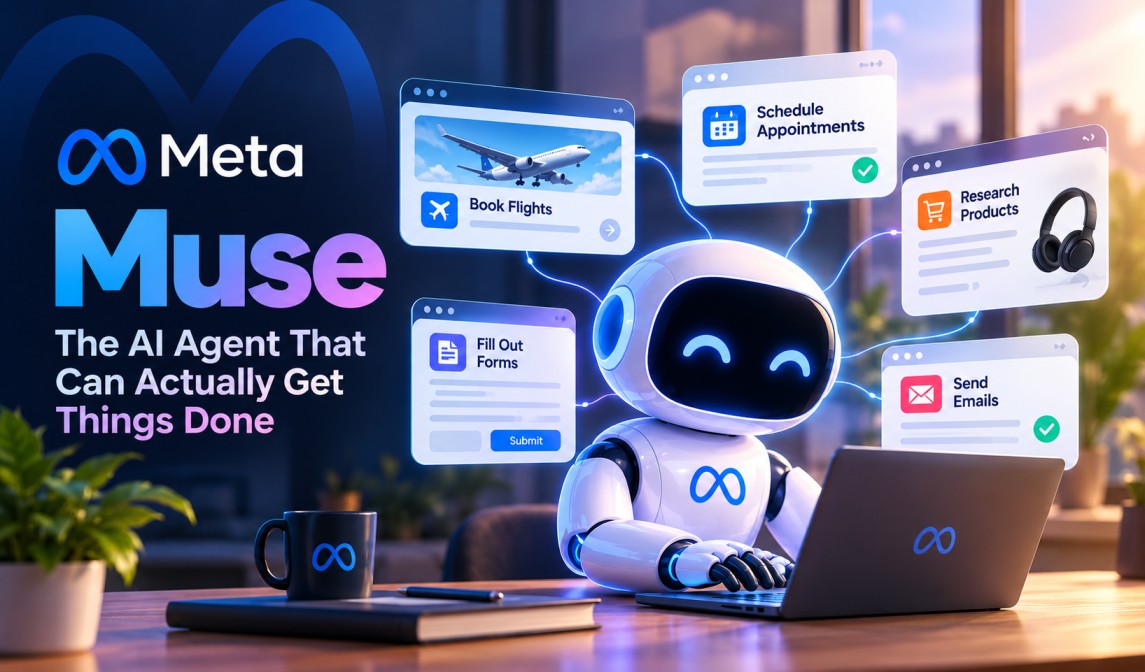
According to Meta, Muse can help with activities such as:
- Booking travel and appointments.
- Filling out online forms.
- Researching products and comparing options.
- Sending emails with appropriate permissions.
- Organizing tasks and schedules.
Muse is designed to work through its dedicated app and WhatsApp, making it feel like chatting with a personal assistant.
Availability in India: As of October 2026, Meta Muse is not available in India. Its initial rollout was announced for the United States.
Official announcement: Introducing Muse — Meta
How Does Meta Muse Work?
The main difference between a regular chatbot and an AI agent is that an agent can use tools to perform actions.
Muse follows a similar approach.
1. Understands your request
You describe what you want in simple language.
For example: "Plan a weekend trip within my budget."
2. Breaks the task into steps
The agent identifies what needs to be done, such as researching destinations and comparing travel options.
3. Uses a browser
Muse can navigate websites, interact with pages, and fill out forms to complete supported tasks.
4. Works toward completion
It can continue working on longer tasks and request your input or approval when needed.
The goal is simple: you describe the result you want, and the AI handles much of the work required to achieve it.
What Is Muse Secure VM?
One of Muse's most interesting technical features is its dedicated virtual machine, called Muse Secure VM.
A virtual machine provides a separate computing environment in which software can run. Muse uses this environment to perform browser-based tasks.
Meta says its security design includes:
- Isolation: The agent runs in a dedicated environment.
- Credential protection: Stored passwords and payment details are protected from direct access by the agent.
- Permission controls: Users choose which applications to connect.
- Approval steps: Certain sensitive actions can require user confirmation.
- Activity history: Users can review the agent's actions.
Meta has also described plans for Muse Confidential VM, which it says will provide additional encryption protections. Its availability should be checked against subsequent official announcements.
These are protections described by Meta, not proof that the system is completely free from security risks.
For developers, the key lesson is that AI agents need secure execution environments, controlled permissions, and ways to review their actions.
What Does Meta Muse Mean for Developers?
AI agents could change how people interact with websites and applications.
Instead of manually opening pages, filling out forms, and clicking buttons, users may increasingly delegate these tasks to AI.
This creates several opportunities for developers.
Build AI-friendly websites
Clear page structures, semantic HTML, accessible form labels, and useful error messages can make websites easier for both people and automation tools to use.
Automate repetitive work
Agents could help collect information, prepare reports, organize schedules, and update records, depending on their available tools and permissions.
Improve APIs and integrations
Well-designed APIs with predictable responses and clear documentation can make it easier for software agents to use an application's features reliably.
Focus on security
Applications must carefully manage authentication, permissions, sensitive actions, and failed operations when AI agents can interact with them.
AI agents will not remove the need for developers. Instead, they may change how software is designed, accessed, and automated.
Is Meta Muse Completely Safe and Private?
Meta says privacy and security are built into Muse's design. The company describes protections for user data, stored credentials, application permissions, and sensitive actions.
These measures are important because an AI agent may interact with personal accounts and perform actions on a user's behalf.
However, no complex software system can be guaranteed to be completely secure. Real-world testing, independent security research, and effective permission controls are important for evaluating such claims.
Users should remain careful when allowing any AI agent to access sensitive information or perform actions such as making purchases.
Is Meta Muse the Future of AI?
Muse represents a wider shift in AI: moving from generating answers to completing tasks.
Imagine asking an AI to organize a trip instead of manually visiting multiple websites. The agent could research options, prepare an itinerary, and ask for approval before making a booking.
However, challenges remain. Agents can misunderstand instructions, make mistakes, or struggle with unexpected website behavior. Their usefulness depends on reliability, security, and access to the right tools.
For developers, this creates an opportunity to build applications that work well with AI-driven workflows.
Final Thoughts
Meta Muse shows how AI is moving beyond conversations toward completing real-world tasks.
Its combination of Muse Spark, browser access, a dedicated virtual machine, and permission controls illustrates how personal AI agents may work.
For users, the benefit could be less repetitive work. For developers, the opportunity is to create applications that AI agents can use safely and reliably.
The next stage of AI may not just be about getting better answers. It may be about turning those answers into actions.
As AI agents become more capable, developers may need to build websites not only for people, but also for AI systems that use them on people's behalf.